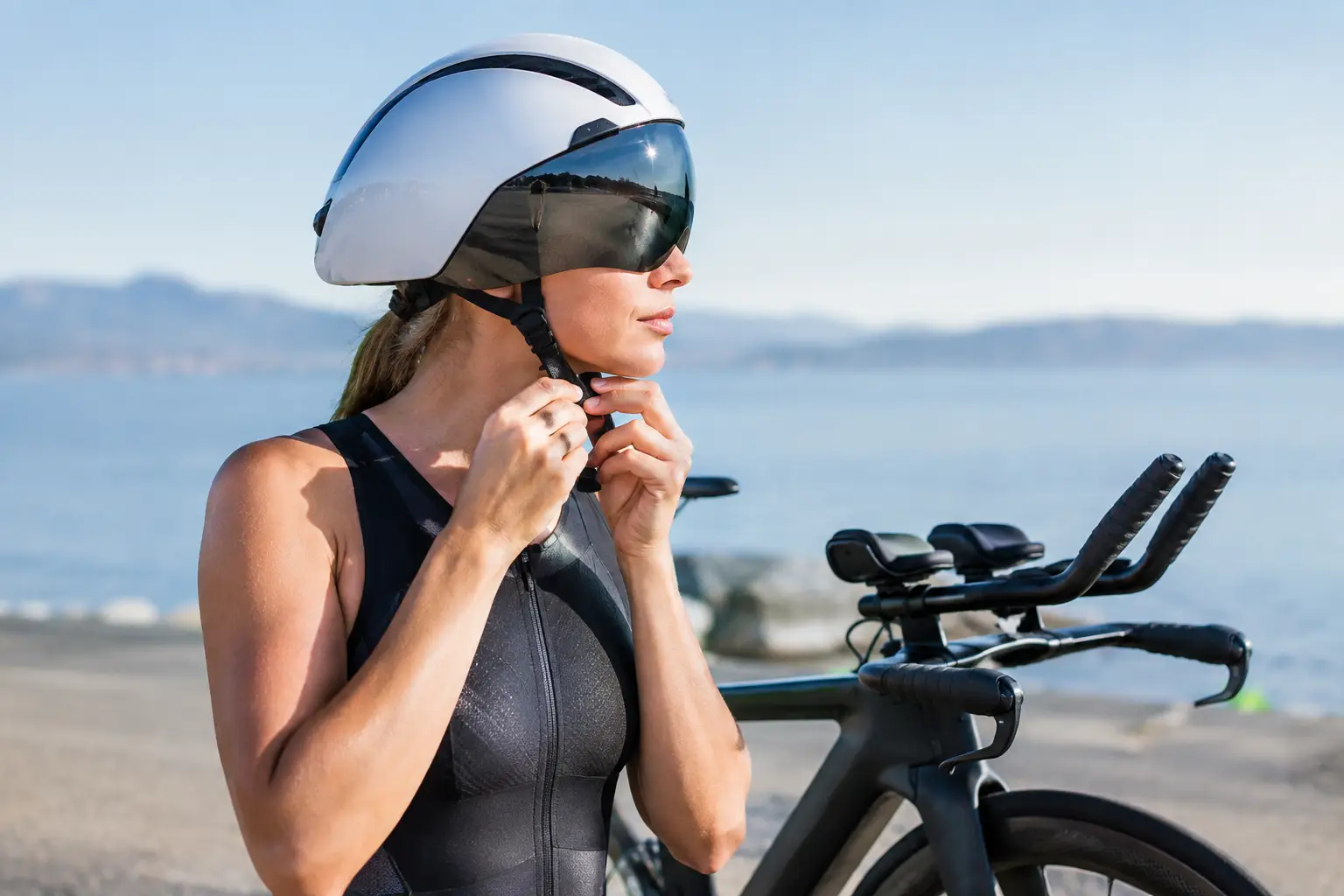
An aero helmet is one of the few upgrades that can save meaningful time without changing your power output. The best aero helmets for triathlon reduce drag across a broad range of riding positions, while still letting you stay cool, see clearly and hold your race posture for the full bike leg. That last point matters more than the headline aerodynamic claim.
A helmet that is exceptionally fast in a wind tunnel but forces you to lift your head, overheats you in the final kilometres or catches air when you look down at your nutrition is not the right race-day choice. For triathletes, the winning option is usually the helmet that works with your actual position on the bike.
What makes an aero helmet fast in triathlon?
Triathlon helmets are designed to manage airflow around the head, shoulders and upper back. Because the rider is a large part of the aerodynamic system, the same helmet can perform differently from one athlete to another. Your cockpit height, shoulder width, head movement and whether you can maintain a low, relaxed head position all influence the result.
The traditional long-tail time trial helmet remains effective for riders who can hold a stable position with the tail sitting close to their back. The smooth transition can reduce turbulence behind the head, particularly in a flat-out 10-mile time trial or a short-course triathlon. Its weakness is obvious when posture changes. If the tail points upward into the wind, its advantage can disappear quickly.
Modern short-tail and truncated aero helmets are more forgiving. Their blunt rear profile is designed to cope better when you look ahead, check a junction, reach for a bottle or sit slightly taller on a climb. For most age-group triathletes, that flexibility makes them the more sensible place to start.
Best aero helmets for triathlon: the main styles
There is no single best shape for every rider, but there are clear categories worth considering before you buy.
Long-tail TT helmets
Long-tail helmets suit athletes with a low, repeatable position and a course where outright speed is the priority. They tend to offer a close-fitting shell around the head and an extended tail that works best when held parallel to the rider’s back.
They are a strong option for sprint and Olympic-distance racing, closed-road time trials and cooler conditions. They demand discipline, however. If your position fades as fatigue builds, a more forgiving design will often be faster over the complete ride.
Short-tail aero helmets
A short-tail helmet gives much of the smooth aero benefit of a dedicated TT lid without requiring perfect head alignment. This design has become a favourite for triathlon because real-world racing involves movement: looking up the road, drinking, navigating aid stations and responding to terrain.
Look for a low-profile shape that sits neatly against your shoulders rather than a helmet that feels bulky at the rear. Many premium models also include integrated visors, which can simplify race-day preparation and improve airflow around the face.
Aero road helmets
Aero road helmets are the practical all-rounder. They are lighter, more ventilated and easier to live with than a full TT helmet, yet they can still offer a worthwhile aerodynamic gain over a conventional road helmet.
They make particular sense for hilly middle-distance courses, hot races, athletes who move around on the bike, and anyone who wants one helmet for training, club rides and triathlon. The trade-off is that they will not usually match a well-suited dedicated aero helmet at high speed. Still, comfort can protect your performance when temperatures rise.
Visor or separate eyewear?
An integrated visor can be quick to put on in transition, gives broad coverage and avoids the gap between sunglasses and helmet. It can also suit riders who find conventional glasses press against their temples when held in an aggressive position.
The downside is ventilation and versatility. A visor may mist in humid conditions, and replacement options can be more limited than standard lenses. Riders who favour separate eyewear should make sure their chosen glasses fit beneath the helmet without creating pressure points or interfering with the retention system.
How to choose the right helmet for your position
Start with your riding position, not the claimed watt saving. A rider on a high-stack, comfort-led tri bike setup has different needs from an experienced time triallist with elbows low and a compact frontal profile. Be honest about the position you can hold after an hour, not just for a photograph at the start of a ride.
If you are new to triathlon or still refining your fit, a short-tail helmet is usually the safer investment. It gives you scope to improve your position without becoming overly sensitive to every head movement. If you already know that your head stays stable and low, testing a longer-tail option may be worthwhile.
Fit is non-negotiable. The helmet should sit level, with the front edge low enough to protect the forehead without blocking your view when on the extensions. It should feel secure before the dial is tightened aggressively. Pressure around the temples, an unstable shell or a retention cradle that catches on your hair will become distracting on race day.
For athletes investing in a premium triathlon bike, professional fit guidance can also help narrow the choice. Your helmet, extensions and head posture should be considered as one system. A few millimetres of adjustment at the arm pads can alter which helmet profile works best for you.
Ventilation is a performance feature
Hot-weather racing changes the calculation. A highly enclosed helmet may test well aerodynamically, but overheating can cost far more time than a small drag penalty. This is especially relevant in middle- and long-distance triathlon, where you need to run well after the bike.
Check the size and placement of the front vents, internal channels and exhaust ports. Large openings are not automatically cooler if airflow does not move effectively through the helmet. Equally, do not assume a sleek, minimal-vent design is unsuitable for summer racing. The best products use internal channel design to move air over the scalp while maintaining a clean exterior shape.
Your own heat tolerance matters. If you regularly finish training rides with sweat running into your eyes, prioritise ventilation and a visor or eyewear setup that remains clear. For cooler British events, a more enclosed aero design can be easier to justify.
Details that matter in transition and training
A race helmet should be fast before you even leave T1. Practise putting it on with wet hands, fastening the buckle and positioning your visor or glasses. Magnetic visors can be convenient, but only if they stay secure when you hit rough tarmac or turn your head sharply.
Consider storage too. Some helmets have a parking position for glasses, while others are designed only around their supplied visor. If you train in changing weather, that practical detail may matter more than a marginal theoretical aero difference.
Weight is rarely the first priority for a flat triathlon course, but it becomes relevant on rolling routes and over longer distances. A heavier helmet can feel tiring at the neck if your position is not well supported. Choose the lightest model that delivers the fit, ventilation and aerodynamic shape you need, rather than chasing grams at the expense of protection or comfort.
A sensible buying checklist
Before committing, compare the helmet against your normal race setup. Wear the same tri suit, use the same extension height, and test it with the eyewear you plan to race in. Pay attention to how naturally you can look forward without craning your neck.
Check that it meets the safety standard required by your event, particularly if you race abroad. Inspect the adjustment range, the availability of replacement visors or pads, and whether the helmet is practical for your usual conditions. A premium aero helmet should feel like a confidence upgrade, not a piece of kit you tolerate for 90 minutes.
The best choice is the one that lets you settle into your fastest sustainable position and stay there. For specialist guidance on pairing a helmet with a race-ready triathlon or TT setup, Trifit Bikes can help you buy with that bigger picture in mind.