A premium bike build can look remarkably similar on paper, yet the drivetrain changes how it feels every time you ride. In the Shimano Di2 vs SRAM AXS decision, neither system is automatically faster or better. The right choice comes down to your riding, preferred gearing, cockpit setup and how you want to manage your equipment before a key event.
For road racers, triathletes, time-trial specialists and committed gravel riders, both systems deliver rapid electronic shifts, excellent braking and proven race-day reliability. The meaningful differences are in the detail: Shimano’s connected battery architecture and familiar two-button logic, against SRAM’s fully wireless design, flexible controls and wide-ranging gearing approach.
Shimano Di2 vs SRAM AXS: the quick answer
Choose Shimano Di2 if you value a highly refined shift feel, conventional 2x road gearing, a single internal battery to charge and a clean, integrated setup on a modern performance bike. It is a particularly strong fit for riders who want a familiar, precise mechanical feel at the levers and minimal battery checks.
Choose SRAM AXS if wireless simplicity, customisable controls, broad cassette options and 1x capability matter most. AXS is especially compelling for gravel, mixed-terrain riding and riders who prefer the flexibility of removable batteries. It is also an excellent option for triathlon and TT cockpits where adding shift points without extra internal wiring can be useful.
The groupset should complement the bike and the rider, not dictate either. A fast bike with the wrong chainring sizes for your terrain or race pace will never feel as effective as a well-matched setup.
Shifting feel: precision versus positive feedback
Shimano Di2 shifts have a controlled, polished character. At the rear, shifts are quick and very quiet when the drivetrain is correctly set up. At the front, Shimano’s 2x systems remain a benchmark, particularly under load. If you often change chainrings on steep ramps, during hard accelerations or while pushing race pace, Di2 delivers a composed and predictable front shift.
The controls are intuitive for many road riders. One lever button moves the chain to a harder gear and the other to an easier gear. It sounds simple, but familiarity counts when you are deep into a race, riding in poor weather or moving through a crowded sportive bunch.
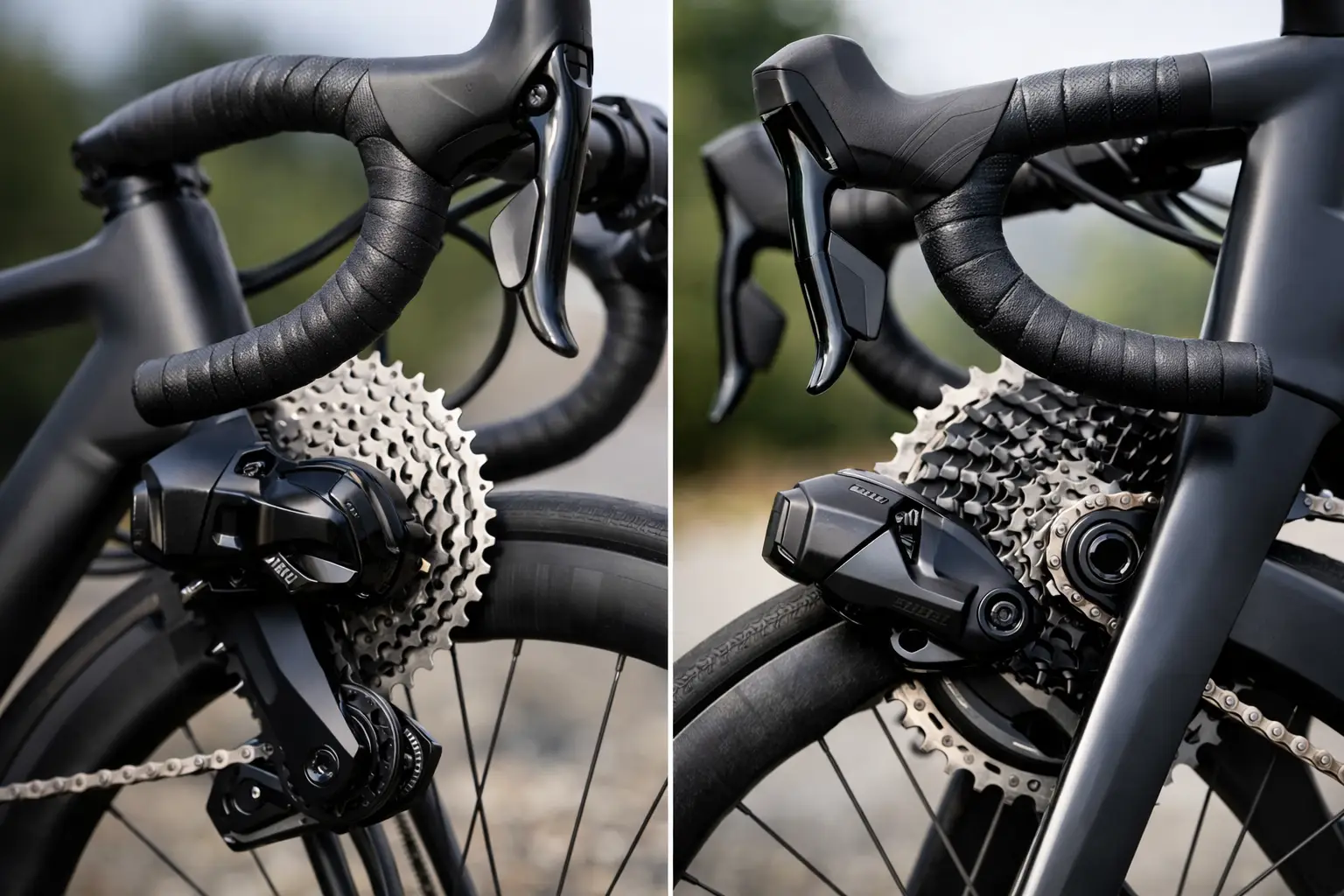
SRAM AXS has a more distinct, mechanical shift sensation. The rear derailleur produces a firmer audible and tactile response, which many riders enjoy because there is no doubt that the shift has happened. The standard control logic uses one lever for an easier gear and the other for a harder gear, while pressing both together controls the front derailleur on 2x systems. It takes little time to learn, and the buttons can be reassigned through the AXS app.
Neither is objectively superior. Di2 feels exceptionally smooth and familiar; AXS feels direct and deliberate. If possible, try both at the hoods and in the drops before choosing.
Gearing matters more than the badge
For most road riders, Shimano’s 2x gearing is the natural starting point. Compact and semi-compact chainset options pair well with closely spaced cassettes, making it easy to hold a steady cadence on rolling roads. Shimano’s 11-tooth smallest sprocket also works with common freehub standards, which can simplify wheel compatibility.
SRAM’s road offering is built around smaller chainrings and 10-tooth smallest sprockets. A 48/35 or 46/33 chainset can deliver low climbing gears without forcing large cassette gaps, while 50/37 and 52/39 options suit stronger racers. These cassettes require an XDR freehub body, so check your current wheels if you are planning an upgrade rather than buying a complete bike.
For riders in flatter parts of the UK or those racing fast time trials, chainring choice deserves proper attention. A low climbing gear is useful, but a rider who regularly spins out on descents or tailwind sections needs enough top end. Equally, gearing that is too large can ruin pacing on a hilly course. Your fitness, event profile and wheel choice should guide the decision.
SRAM has an advantage for riders who want a 1x drivetrain. Removing the front derailleur creates a simple, quiet setup with strong chain retention, and the wide-range cassette options make real sense for gravel and cyclocross. For pure road racing or long-course triathlon, many riders still prefer the tighter cadence steps of 2x.
Battery charging and race-week confidence
Shimano Di2 uses a central internal battery that powers both derailleurs. On modern road groupsets, the levers can communicate wirelessly while the derailleurs remain connected to the main battery. Charge one battery and, for most riders, forget about it for a long time. Battery life is a major Di2 strength.
The trade-off is installation complexity. A full Di2 build requires internal wiring, and fitting or changing components is best handled carefully. On an integrated aero bike, that work can take more time than a wireless system.
SRAM AXS uses removable batteries on each derailleur, with coin-cell batteries in the shifters. The derailleur batteries are small, swap in seconds and can be charged away from the bike. Carrying a spare in a saddle bag is straightforward insurance for travel, multi-day events or a missed charge.
That convenience creates a routine: you need to check both derailleur batteries. SRAM’s front and rear batteries are interchangeable, so a low rear battery can be swapped with the front in an emergency, but this is not a race-morning plan. Whatever system you choose, make battery charging part of your pre-event checklist.
Cockpit options for triathlon and TT
Aero cockpits make the Shimano Di2 vs SRAM AXS choice more interesting. Di2 offers a mature range of satellite shifters and extensions controls, allowing shifts from the base bar and aerobars. On a purpose-built TT machine, the wired system can be very tidy once installed, and the single main battery remains convenient for long events.
AXS makes multi-position shifting impressively flexible. Wireless Blips can be placed where they suit your hand position, which is useful when refining an aero setup or fitting a cockpit with limited cable-routing options. That can reduce installation hassle and help maintain a clean front end.
However, the fastest triathlon setup is not simply the one with fewer wires. It is the one that lets you shift confidently while staying in position, with gearing appropriate for the course. Before committing, consider how your chosen frame, extensions, brake levers and hydration system work together.
Braking and overall system integration
At equivalent groupset levels, both brands offer powerful hydraulic disc braking with excellent modulation. Lever shape and reach are more personal than absolute braking performance. Shimano levers often appeal to riders wanting a compact, familiar road feel, while SRAM’s controls can suit riders who prefer their hood shape and adjustable reach.
Do not select a drivetrain on brake feel alone. Tyres, rotors, pad compound and setup quality have a substantial effect on stopping performance. A correctly bedded-in brake system on a well-built bike matters more than internet arguments over marginal differences.
Both ecosystems have polished companion apps. Shimano E-Tube supports adjustment and shift-button configuration, while SRAM AXS focuses on custom control assignments, firmware updates and component management. SRAM’s cross-category ecosystem is especially attractive if you already use AXS on a gravel or mountain bike. Shimano’s broad availability and long-standing road heritage will be equally persuasive for other riders.
Which system should you buy?
There is a clear case for Shimano Di2 on a race-focused road bike, particularly if you want close-ratio 2x gearing, excellent front shifts and less frequent charging. It is a confident choice for riders who want their drivetrain to work quietly in the background while they concentrate on speed, position and pacing.
SRAM AXS deserves serious consideration if your riding crosses road, gravel and cyclocross, if you value 1x, or if a wireless installation makes sense for your frame and cockpit. The ability to remove and carry a spare battery is practical, and customisable controls are valuable when you want the bike configured around your preferences.
Check the exact specification rather than relying on the brand name alone. Rival AXS, Force AXS and Red AXS are not identical, just as Shimano 105 Di2, Ultegra Di2 and Dura-Ace Di2 offer different weights, finishes and features. Wheel freehub compatibility, crank length, power-meter requirements and available stock can all affect the final build.
For a significant purchase, use fit and intended use as the starting point. At Trifit Bikes, the best premium bike choice is always the one that puts you in the right position, delivers usable gearing and gives you confidence to ride harder. Choose the drivetrain that supports that goal, then spend your energy where it counts: training for the next start line.